
 In the modern healthcare landscape, the line between patient care and information technology has effectively disappeared. Every diagnosis, prescription, and treatment plan generates a digital footprint, creating a vast and complex ecosystem of sensitive data. For healthcare organizations, protecting this information is no longer just a compliance mandate; it is a fundamental pillar of patient safety and institutional trust. A data breach in this sector carries consequences that transcend financial penalties, directly and dangerously impacting clinical outcomes and human lives.
The numbers are stark: the healthcare industry has suffered the highest data breach costs for many years, reaching an average cost of $10.93 million per incident in 2023, according to IBM's latest report.
This article moves beyond the headlines to explore why data security is inseparable from patient care, diagnose the evolving threat landscape, and outline the proactive strategies necessary to build a truly resilient defense.
Why Every Byte of Patient Data is a High-Stakes Asset
When we discuss Protected Health Information (PHI), we are referring to something far more profound than a digital medical chart. We are describing a patient's "digital twin." Each piece of information is a component of a person's most intimate identity. This includes obvious identifiers like demographics, detailed medical history, and genetic information, but it also extends to billing records, insurance details, and even the IP addresses used to access a patient portal.
The true value for threat actors lies not in single data points, but in their aggregation. This collection of data forms a complete personal profile, which is highly valuable on the black market, worth up to 50 times more than personal financial information.
However, the consequences of this data being compromised go far beyond its illicit market price. Its integrity and availability are paramount to delivering effective medical care. This brings us to the clinical imperative, where the core principles of cybersecurity—confidentiality, integrity, and availability—have life-or-death parallels.
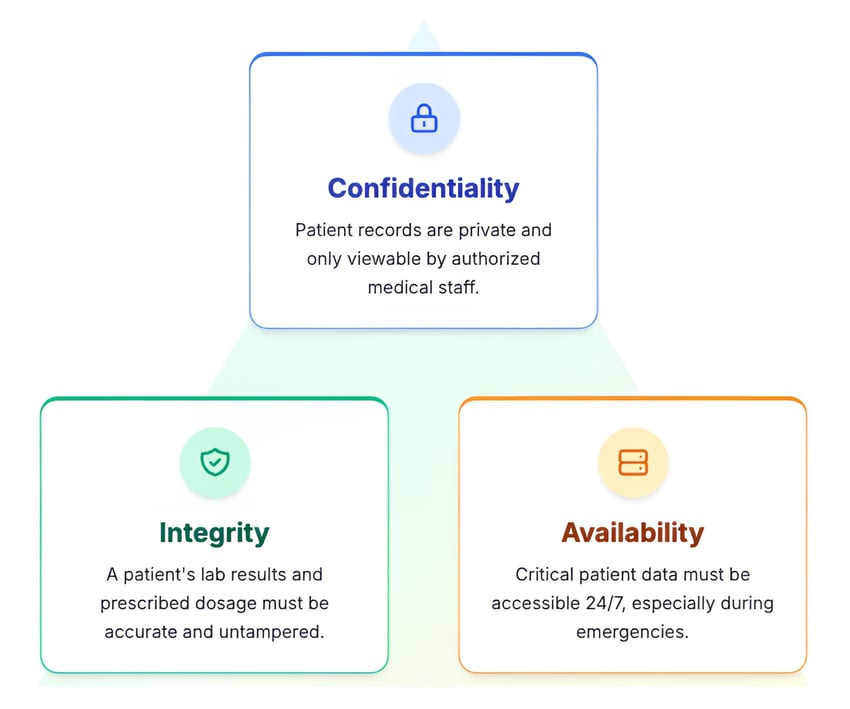 Figure 1: The CIA Triad in Healthcare
- Data Availability as a Lifeline: Consider a ransomware attack that encrypts a hospital's entire electronic health record (EHR) system. This is not a simple IT inconvenience; it is a system-wide denial of care that can increase mortality rates. Surgeons lose access to pre-operative notes, oncologists cannot review chemotherapy protocols, and emergency room physicians are left blind to patient allergies. Delayed or incorrect treatment becomes an immediate and life-threatening risk.
- Data Integrity as a Clinical Necessity: If a malicious actor infiltrates a network and alters patient data, the consequences can be catastrophic. Imagine a patient's blood type being changed, a decimal point shifted in a medication dosage, or a critical allergy deleted from their record. Such alterations can lead directly to misdiagnosis, incorrect prescriptions, and fatally flawed treatment plans. The integrity of patient data is synonymous with the integrity of the care provided.
- Data Confidentiality as the Bedrock of Trust: The exposure of sensitive diagnoses—such as mental health conditions, substance abuse treatment, or infectious diseases—can cause profound psychological and social harm. Patients may avoid seeking necessary care for fear of exposure, leading to negative long-term public health outcomes. Protecting confidentiality is not just about avoiding embarrassment; it's about creating a safe environment where patients feel secure enough to be honest with their providers.
Are You Prepared for Healthcare's Top Cyber Threats?
Building on the understanding that data is a clinical asset, we must now diagnose the "pathogens" threatening the healthcare ecosystem. These threats are both external and internal, requiring a comprehensive security strategy.
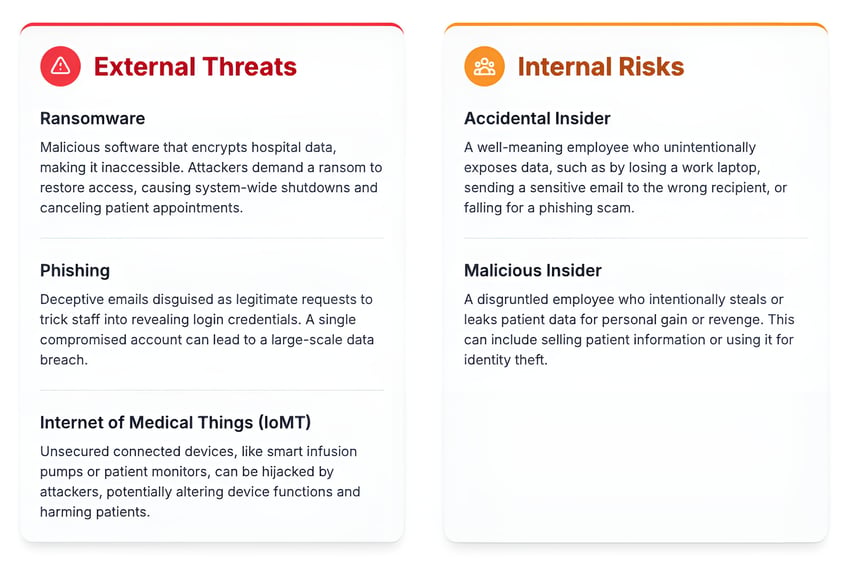 Figure 2: A comparison of dangers originating from outside and inside an organization.
The most prominent external threats are sophisticated and relentless. Ransomware has emerged as the digital equivalent of a hospital superbug. The 2020 attack on Universal Health Services (UHS), one of the largest healthcare providers in the U.S., reportedly cost the company $67 million and forced clinicians to revert to pen and paper, delaying care across hundreds of facilities. This incident was a wake-up call, underscoring the systemic vulnerability of the entire sector.
Spear-phishing remains a highly effective vector, with the Verizon 2023 Data Breach Investigations Report noting that a staggering 74% of all breaches involve the human element. These socially engineered emails prey on the high-stress environment of clinical settings, tricking staff into divulging credentials or deploying malware that allows attackers to move laterally through the network.
Furthermore, the proliferation of the Internet of Medical Things (IoMT) has exponentially expanded the attack surface. Network-connected infusion pumps, pacemakers, and patient monitors are all potential entry points. Expert tip: An accurate and up-to-date IoMT asset inventory is the absolute first step. You cannot protect what you do not know you have. Many of these devices were not designed with security as a primary concern, leaving them vulnerable to exploits.
While external actors grab headlines, internal conditions can be just as damaging. The accidental insider is a common yet potent threat—the well-meaning but undertrained employee who clicks a malicious link or misconfigures a cloud database. These actions are not malicious, but they can have consequences as severe as any targeted attack. The malicious insider, conversely, acts with intent, whether for financial gain or revenge. Their legitimate access makes them difficult to detect without robust internal monitoring and access control policies.
Navigating this complex threat landscape requires a baseline standard of care, which is where compliance frameworks like HIPAA and GDPR come into play. These are not bureaucratic hurdles, but the established "minimum standard of care" for data health. HIPAA’s core tenets—the Security Rule, Privacy Rule, and Breach Notification Rule—provide a solid foundation for protecting PHI. Failure to adhere to these standards results in a critical prognosis: financial penalties, a corrective action plan, and reputational damage. If you are unsure whether your current safeguards meet these rigorous requirements, a professional Security Gap Analysis service can identify potential compliance gaps and provide a clear roadmap for remediation.
Prescribe a Proactive Plan for Digital Resilience
Compliance is the baseline, but true security requires a proactive, multi-layered defense strategy—a resilient digital immune system designed to neutralize the pathogens we've just diagnosed. This involves a synthesis of technical defenses, human vigilance, and emergency preparedness.
The first layer involves essential technical "immunizations." End-to-end encryption using strong cryptographic standards like AES-256 is non-negotiable for data both at rest and in transit. A modern security posture must also fully embrace a Zero-Trust architecture. The traditional "castle-and-moat" model is obsolete. Zero Trust operates on the principle of "never trust, always verify," meaning every user and device must be authenticated before accessing any resource. This micro-segmentation contains potential breaches, preventing an attacker from moving freely across the network.
Complementing this is a robust vulnerability management program. This is the equivalent of a regular health check-up for all IT systems, especially the IoMT devices we identified as high-risk. Continuous scanning and patching are essential to remediate weaknesses before they can be exploited. Implementing a robust vulnerability management program ensures these "health check-ups" are performed consistently and effectively, protecting your most critical systems.
Technology alone, however, is not a panacea. Your most critical line of defense is the human firewall. To be effective, employees must be transformed from potential liabilities into active security advocates. This requires moving beyond simplistic annual training videos. A mature security awareness program moves beyond simplistic annual videos and involves continuous, role-based education. A key component is providing practical experience through realistic phishing simulations that condition employees to identify and report threats. This hands-on training is critical for cultivating a pervasive culture of security, where every individual—from surgeons to receptionists—understands their role and feels empowered to act as a security advocate.
Finally, even with the best defenses, organizations must prepare for a "Code Blue" data breach. An Incident Response Plan (IRP) is an essential protocol for survival. A well-defined IRP outlines the precise steps for containment, eradication, and recovery. Just as hospitals run fire drills, they must conduct regular tabletop exercises to pressure-test their IRP, ensuring every team member knows their role when a crisis occurs.
Evolve from Compliance Checklists to a Culture of Trust
In healthcare, data security is unequivocally a patient care issue. The digital and physical well-being of a patient is now inextricably linked. As we've seen, a compromised server can lead to a compromised treatment plan; a stolen password can endanger a life.
The ultimate goal of a robust cybersecurity program extends far beyond avoiding regulatory fines. It is about building unshakable patient trust and ensuring the continuity and safety of care. By reframing security from a compliance checklist to a cultural cornerstone, you safeguard the very integrity of your mission.
For every healthcare leader and IT administrator, the challenge is clear. It is time to stop viewing cybersecurity as a cost center. Your next security investment is a direct investment in your patients' well-being, the resilience of your operations, and the future of your organization.
Ready to transform your security posture? Contact NRI Secure today for a comprehensive consultation and learn how our suite of managed security services can protect your most critical assets.